Why Pi Shows Up in Places That Have Nothing to Do With Circles
A fun bit of high school math help: discover where pi secretly shows up outside of circles, from probability to the bell curve.
A fun bit of high school math help: discover where pi secretly shows up outside of circles, from probability to the bell curve.
Introduction

Ask a student where pi shows up, and “circles” is the obvious answer. Fair enough. But pi has a habit of showing up in places with no circle anywhere in sight, and that’s exactly the kind of high school math help moment that tends to stick.
Pi Isn’t Just About Circles Anymore
Pi quietly appears in statistics, physics, and probability formulas that have nothing visibly round about them.
The bell curve used to describe everything from test scores to height distributions has pi built directly into its formula. There’s no circle being measured, pi is just baked into the math itself, because of how the curve is shaped. It even shows up in the equation physicists use for
Heisenberg’s uncertainty principle, a formula about particles, not circles, with pi sitting right in the middle of it.
You Can Calculate Pi by Dropping a Needle on the Floor
Seriously. Drop a needle on a lined floor enough times, and the odds of it crossing a line will edge you toward the exact value of pi.
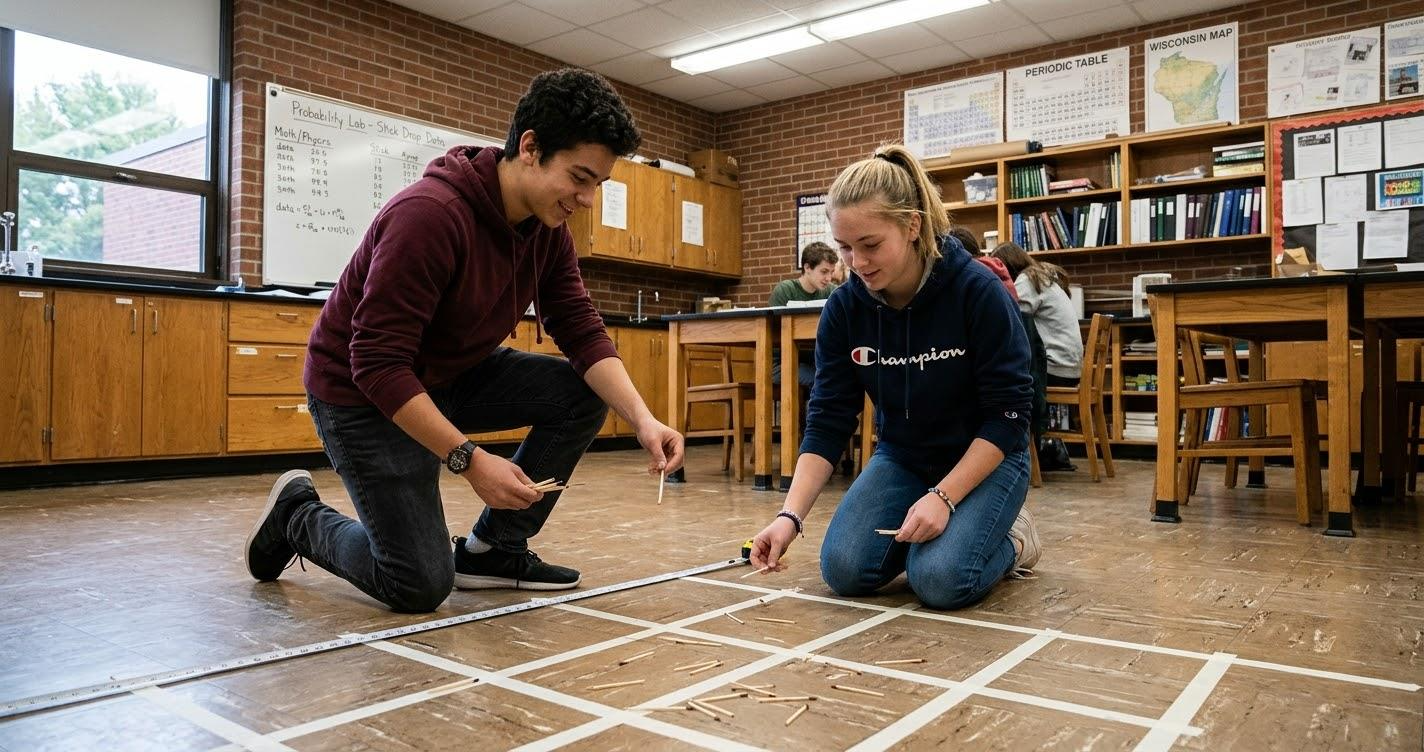
This is known as Buffon’s Needle Problem, first posed in the 1700s, and it’s one of the oldest known ways to estimate pi using nothing but probability and a steady hand, no circle required.
Here’s the fun part: the more times you drop the needle, the closer the result creeps toward pi. One mathematician actually tried this nearly 3,500 times in 1901 and landed on a value accurate to six decimal places, all from tossing a needle onto a lined sheet of paper, over and over, with a lot of patience.
Why Pi Keeps Showing Up Everywhere
Pi tends to appear whenever something involves rotation or symmetry, even if no actual circle is drawn anywhere. It’s less “the circle number” and more “the number that shows up whenever something turns or repeats,” which ends up being a lot more often than most students expect.
Waves, orbits, pendulums, sound, anything that oscillates or loops back on itself tends to drag pi along with it. A circle just happens to be the simplest, most visible example of that kind of repeating motion, which is probably why it got top billing in the name.
We like using fun math facts like this one in sessions, not because they’re on a test, but because they’re proof that math concepts rarely stay in their assigned lane. If your student is only meeting pi through circle formulas, math tutoring in Green Bay is usually where that bigger picture gets filled in.
Final Thoughts
Pi turns out to be less “the circle number” and more “the number that shows up whenever something turns or repeats,” which is exactly the kind of connection real high school math help is built to make.