Why Dividing by Zero Breaks Math (And What Actually Happens)
Real high school math help for one of math’s strangest rules: why dividing by zero is undefined, and what actually happens when you try.
Real high school math help for one of math’s strangest rules: why dividing by zero is undefined, and what actually happens when you try.
Introduction

Type any number divided by zero into a calculator, and you’ll get an error instead of an answer. It's one of the first “wait, why not?” moments in math class, and a genuinely good bit of high school math help once it actually clicks.
Division Is Secretly Just “Undo Multiplication”
Division only works because it can reverse multiplication, and dividing by zero breaks that reversal completely.
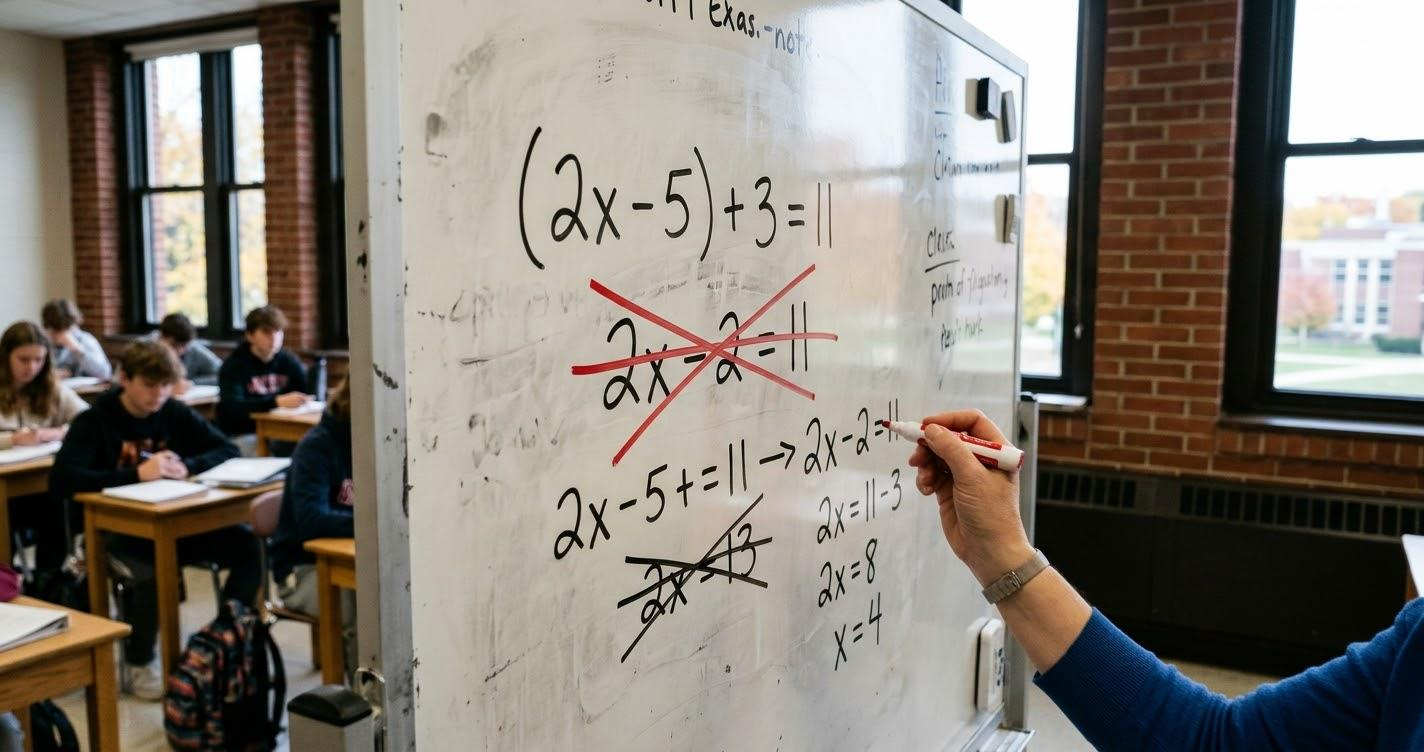
If 10 ÷ 0 equaled some number, multiplying that number by 0 would need to bring you back to 10. But anything multiplied by zero is always zero, never 10. There’s no number that can make the equation work, so mathematicians call it undefined rather than force a fake answer.
Even the special case of 0 ÷ 0 doesn’t get a free pass. By that same logic, x × 0 = 0 is true for literally every possible value of x, which means there isn’t one unique answer, there are infinitely many. Mathematicians call this one indeterminate, a slightly different flavor of “this doesn’t work” than a regular undefined expression.
It’s worth sitting with that distinction for a second: undefined means no answer fits, indeterminate means too many answers fit. Two very different kinds of “this doesn't work,” and knowing which one applies actually matters once calculus enters the picture.
So What Does a Calculator Actually Do?
That “Error” message isn’t the calculator being confused, it’s the calculator correctly refusing to break the rules of arithmetic.
Calculators are programmed to recognize division by zero and stop rather than guess. It’s less a glitch and more a built-in respect for a rule that mathematicians have never been able to get around, no matter how many centuries they’ve had to try.
A common guess is that dividing by zero should just equal infinity. It’s a reasonable instinct, since dividing by smaller and smaller numbers does produce bigger and bigger results, but
infinity isn’t a number you can land on exactly, it’s just a direction the result keeps heading toward. Undefined and infinite end up being two very different ideas.
Why Mathematicians Care So Much About This One Rule
This single rule protects the entire logical structure of algebra. Allow division by zero just once, and it's possible to “prove” that 1 equals 2, which would quietly break every other math rule built on top of it.
It’s a small fun math facts moment with a big payoff: showing a student why a rule exists, instead of just telling them to memorize it, is exactly the approach we lean on in math tutoring in Green Bay. Rules that make sense are a lot easier to remember than rules that just get handed down.
To Conclude
Dividing by zero breaks math because it breaks multiplication’s reversal, not because of some arbitrary rule, and showing a student why a rule exists instead of just handing it down is the whole idea behind real high school math help.