5 Fun Math Facts That Sound Fake But
A fun break from regular math tutoring in Green Bay: from the birthday paradox to why sunflowers follow a math pattern, these facts make math more interesting.
Aren’t
A fun break from regular math tutoring in Green Bay: from the birthday paradox to why sunflowers follow a math pattern, these facts make math more interesting.
Introduction

Math has a reputation for being dry. These facts don’t help that reputation, they just make it a lot more interesting, and they’re exactly the kind of thing we like sprinkling into math tutoring in Green Bay sessions, plus a couple are genuinely fun to spring on a friend who insists they’re “right” about something.
Math Isn’t Always What It Looks Like on the Surface
Every fact on this list follows the same pattern: something that sounds like it should be simple turns out to have a surprisingly clean piece of math sitting underneath it. That’s usually how the best high school math help conversations start, they’re not complicated once you see them, they’re just not what your gut expected.
In a Room of 23 People, Two Probably Share a Birthday
With just 23 people in a room, there’s better than a 50% chance two of them share a birthday.
It’s called the birthday paradox, and it feels wrong because our brains compare one date to one date, when really there are hundreds of possible pairs being compared at once.
0.999... Repeating Forever Actually Equals 1
Not approximately equal, exactly equal, no rounding involved.
One-third equals 0.333... repeating forever. Multiply both sides by 3, and 3/3 (which is 1) equals 0.999... repeating forever. It looks like a trick, but it holds up under every method mathematicians have thrown at it, and it’s one of the few facts that genuinely divides a room every time it comes up, usually right up until someone actually works through the fractions themselves.
Sunflowers Are Doing Algebra Without Knowing It
Sunflower seed spirals follow the Fibonacci sequence, the same number pattern that shows up in pinecones, shells, and hurricane shapes.
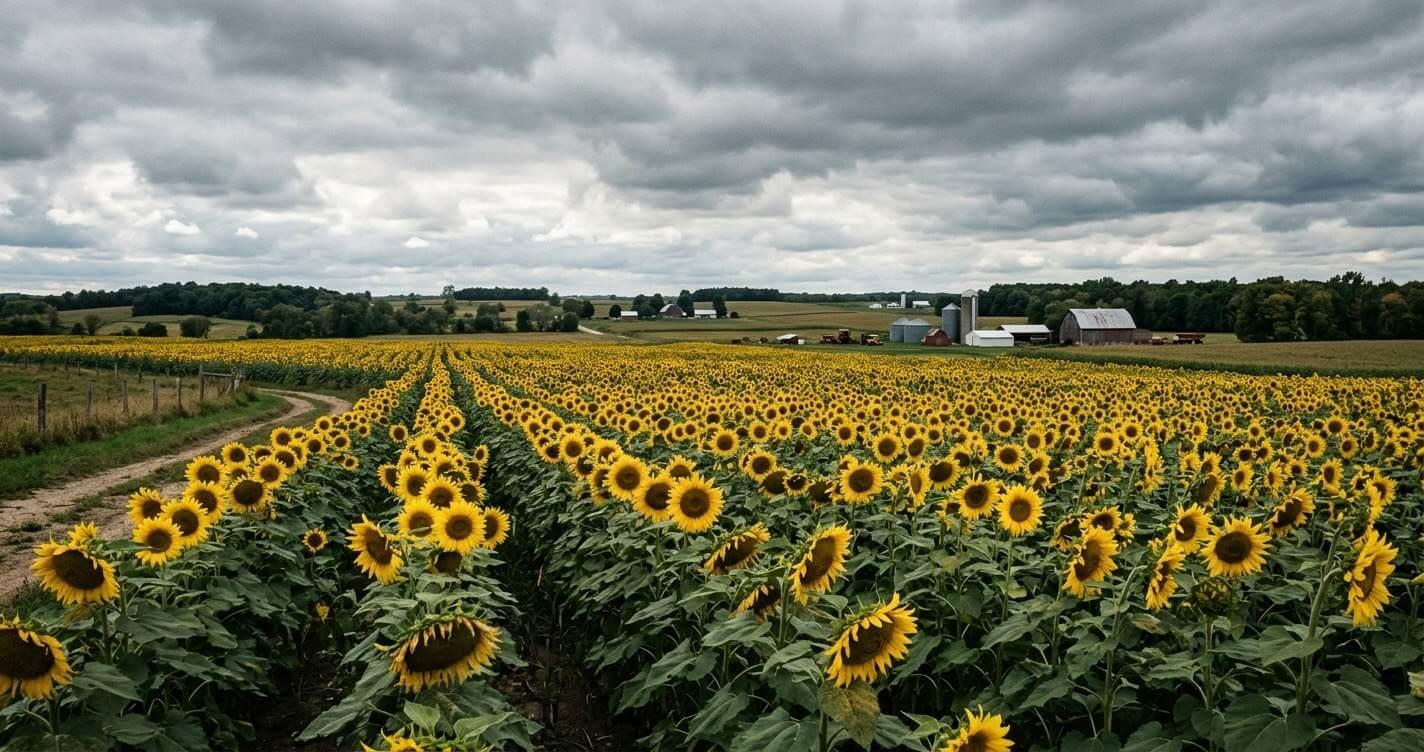
Each number in the sequence is the sum of the two before it (1, 1, 2, 3, 5, 8, 13...), and nature keeps reusing it because it happens to be one of the most efficient ways to pack things into a limited space. Next time you’re near a farmers market or driving past a Wisconsin sunflower field in late summer, it’s worth actually counting the spirals, they’ll almost always land on a Fibonacci number.
Zero Wasn’t Always Considered a Number
The concept of zero as a true number, not just a placeholder, is generally credited to Indian mathematicians around the 5th to 7th centuries.
Before that, entire number systems (including the Romans) got by without it. It was the 7th- century astronomer Brahmagupta who became the first known scholar to treat zero as a number in its own right, laying out formal arithmetic rules for it. Once zero was treated as a real number with its own rules, it quietly rebuilt the foundation for algebra, calculus, and eventually computers. It’s a good reminder that even the most “basic” parts of math, the stuff nobody thinks twice about, took real human effort to figure out.
Where We Land
None of these fun math facts will show up word-for-word on a test. But they’re a good reminder that math isn’t just a subject to survive, it’s a way of noticing patterns most people walk past every day. We like sneaking a few of these into math tutoring in Green Bay sessions when a student needs a reminder that math can actually be interesting, not just something standing between them and the weekend.